
Sandeep
Shivashettar
I take ideas from model to production — a live education platform, medical AI research built to journal standard, and an industrial optimization engine that replaced manual planning.
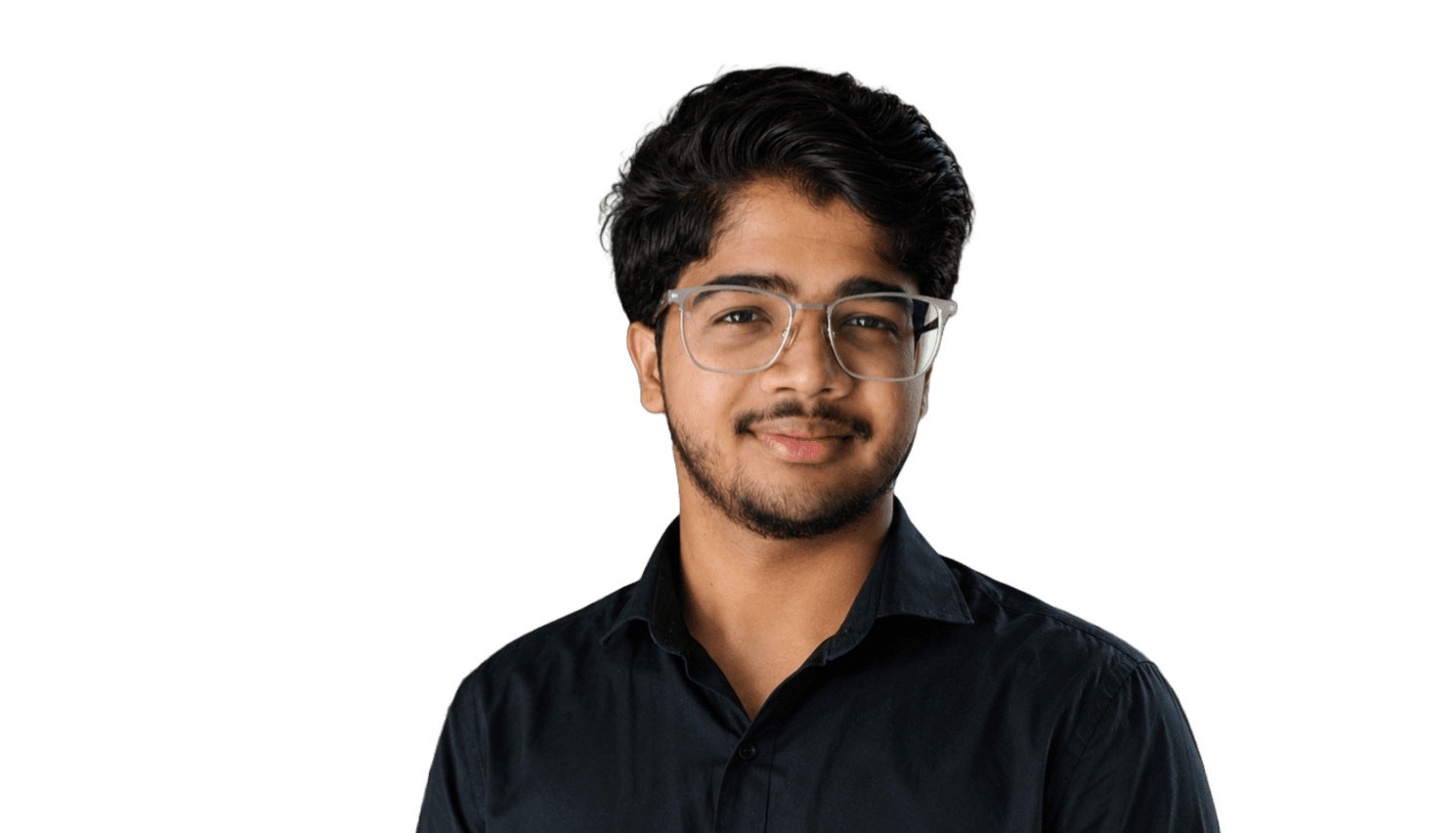
Sandeep Shivashettar
Currently building Skilvi
Five capabilities, one builder.
The common thread isn't a stack — it's the habit of going deep enough in each domain that the work holds up on its own terms, whether that's a payment pipeline, a steel-coil cutting problem, or a diagnostic model.
Build Intelligence
ML, deep learning, NLP, forecasting, retrieval-augmented generation.
Build Systems
Backend architecture, APIs, databases, cloud infrastructure.
Build Products
Full-stack interfaces shipped to real users, not prototypes.
Understand Use
Owning product strategy end-to-end — from client requirement to operator workflow.
Ship
Getting systems into production and keeping them running.

Skilvi —
Education, built like production software.
The problem with most educational platforms isn't the content — it's the friction. Skilvi is an LMS ecosystem architected from the ground up to handle student enrollments, payment processing via Razorpay, automated certification, and career placement tracking without manual intervention. It's not a demo; it's a live, scalable product processing real users.
Founded
2026
Status
Live
Ecosystem
Skilvi + EmberQuest


Founder & Product Engineer
Processing real enrollments & payments
I'm interested in the decisions behind the technology.
I don't start by looking for the answer — I start by checking why the problem exists and what assumptions are hiding behind it. That habit sits at the intersection of systems thinking, first principles, and paying attention to how people actually behave.
I question the obvious
When everyone's optimizing for the same thing, I check whether it's the right thing to optimize for first. Then I break the problem into smaller systems and go after the variable that moves the most.
Decisions, not just ideas
An idea is worth little until it survives constraints. Every real decision runs through evidence, assumptions, alternatives, risk, and expected impact — and I try to keep those five things separate.
People aren't rational
Users have habits, incentives, and shortcuts. “Can we build this” matters less than “why would someone actually trust it, pay for it, or abandon it.” That question usually changes the product.
Uncertainty is a variable, not a blocker
Good decisions don't need perfect information — they need to know which uncertainty matters and what's the fastest experiment to reduce it. A small real test beats a long theoretical debate.
Think deeply. Build quickly. Measure honestly. Change direction when the evidence demands it.
It's why the RAG assistant is built to say "I don't know" instead of guessing, and why the steel-coil optimizer went through five certified phases instead of shipping the first working version. My goal isn't to always be right — it's to build a process that gets closer to the truth faster.
Not just a model-runner.
A systems thinker.
I'm an Artificial Intelligence and Data Science undergraduate at M. S. Ramaiah Institute of Technology (MSRIT), Bengaluru, with a CGPA of 7.96/10 — working at the point where applied machine learning research meets production software.
That combination shows up as delivered work, not just interest: three peer-reviewed papers in medical AI and signal classification, and Skilvi — a learning platform I founded and still operate, handling live student enrolments, payments, and certification.
Professionally, I hold every system to the same standard: define the problem precisely, build something that solves it, and prove it holds up under real-world constraints before calling it done.
That standard is why a steel-coil optimization engine I built is certified across five production phases at a manufacturing client, and why freelance clients return for measurable outcomes, not demos.
Location
Bengaluru, India
Education
B.E. AI & DS, MSRIT
Experience
Founder & Product Engineer
Published
IEEE Standard Journals
Selected Systems
Moving beyond models to complete, deployable architectures. Scroll down to explore each.
What's in progress.
Not everything ships as a finished case study. This is what's actually on the bench right now.
Skilvi — placement & instructor analytics
Enrolment, payments, and certification are live. Career placement tracking is the next surface, plus visibility for instructors and ops staff.
RAG re-ranking & confidence scoring
The medical-report RAG assistant retrieves and answers well; next is a re-ranking pass and confidence scores so it stops short of a claim it can't support.
Generalizing the OR-Tools slitting engine
The steel-coil optimizer is certified and shipped. Testing whether the same constraint formulation holds up on adjacent scheduling problems.
Next research submission
Three papers in medical imaging and signal classification are done. Scoping the next architecture before committing to a dataset.
Research
Built to IEEE journal quality — reproducible pipelines, interpretability (Grad-CAM, attention maps), and real held-out evaluation, not just training accuracy.
FusioNet-DR
A dual-stream network that reads retinal images two ways at once — spatially and in the frequency domain — then fuses them with attention to grade diabetic retinopathy severity as an ordinal problem, not a guessing game between five unrelated classes.
CBAM-CNN-BiLSTM
ECG arrhythmia classification with a debugging story: the standard wfdb library had a parsing bug, so I wrote a custom binary .atr parser to get clean ground-truth labels before the model ever saw the data.
STAMP-Net
Oral cancer detection from whole-slide pathology images too large for any CNN to see whole — solved with attention-based multiple-instance learning, plus an adversarial mechanism that strips out stain-color bias so the model generalizes across labs.
Let's build something
Work
Together.
Open to AI engineering roles, freelance ML projects, and research collaborations. Based in Bengaluru — available globally.